
Blog
How to Check Colorfastness on Nylon Elastane Fabric: Washing, Perspiration, Rubbing, and Light
Quick answer: Colorfastness on polyamide elastane fabric comes down to four checks: washing, perspiration, rubbing (dry and wet), and light. Dark shades are more prone to bleeding and staining, with wet rubbing the usual weak point; pale shades show light fading and yellowing more easily. Simple swatch tests help you screen samples, but the final word belongs to a testing lab working to the methods agreed in your order.
What does colorfastness actually mean?
Colorfastness describes whether a fabric's color holds up through washing, sweat, rubbing, and sunlight—both on the fabric itself and on what it touches. Colorfastness (also written color fastness, or dye fastness) is usually judged two ways: color change (fading / shade shift) of the fabric itself, and staining (color transfer / bleeding) onto adjacent white or pale fabric. Nylon-elastane knits—known in the trade as polyamide elastane or nylon spandex—take acid dyes on the nylon, while the elastane dyes lighter, so each condition needs its own check. Maoxing Textile Dyeing has worked these weft knits at Zhongda Guangzhou for 15 years, and "will this bleed?" is one of the questions buyers ask us often.
What do the four tests measure?
Washing, perspiration, rubbing, and light each cover a different real-life stress, so one result cannot stand in for another. Washing fastness (wash fastness / laundering) simulates home washing and checks fading plus staining on an adjacent fabric. Perspiration fastness (sweat fastness) uses simulated acid and alkaline sweat—key for intimates and activewear. Rubbing fastness (crocking) is split into dry and wet: a white cloth is rubbed on the fabric and the color picked up is judged. Light fastness (lightfastness / sun fading) exposes the fabric to an artificial light source. Chinese national methods include GB/T 3921 (washing with soap), GB/T 3922 (perspiration), GB/T 3920 (rubbing), and GB/T 8427 (artificial light: xenon arc); use the current edition and whatever your order specifies.
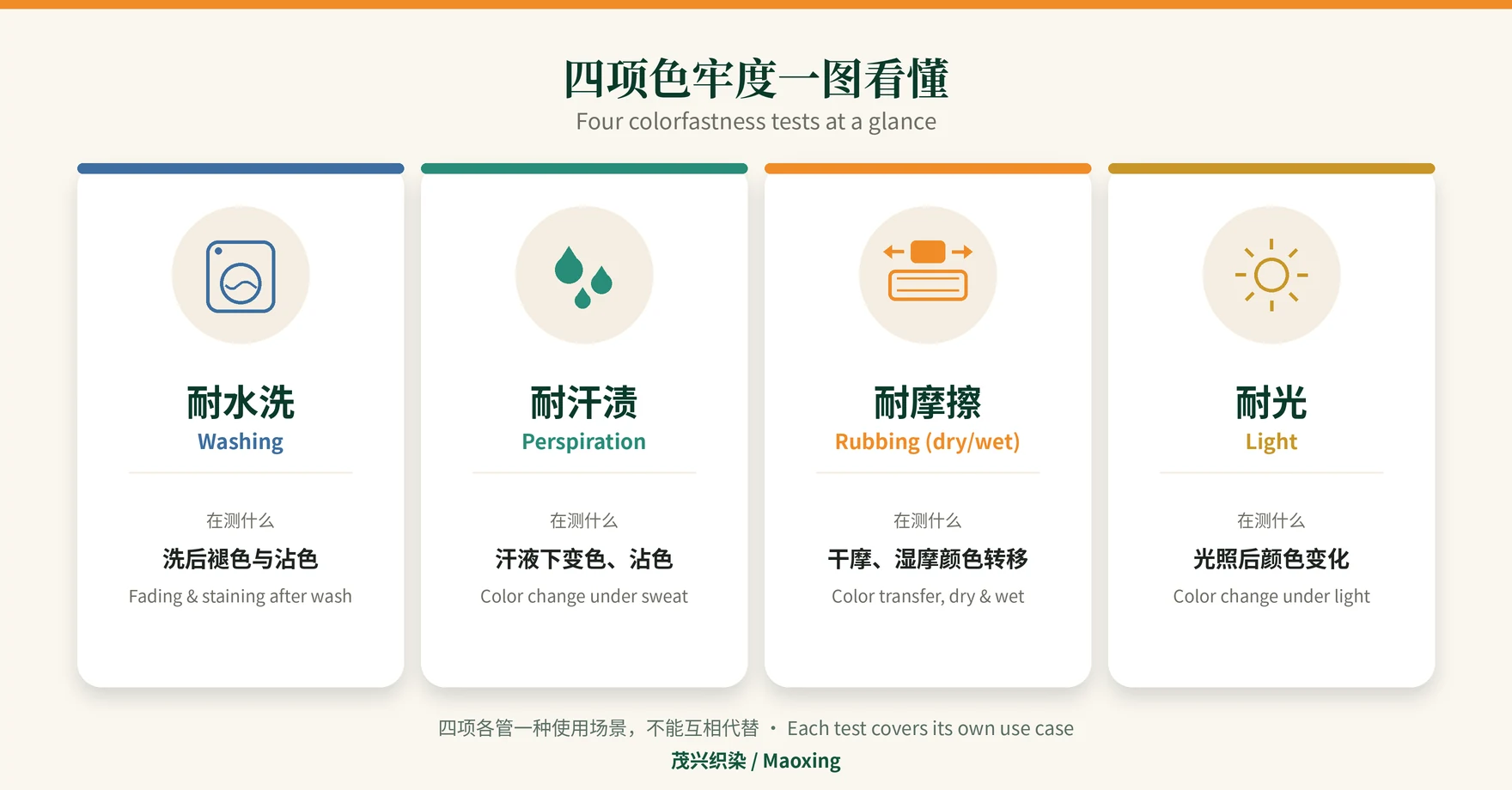
Four-test comparison table
This table shows what each test measures, typical problems, and a quick swatch check.
| Test | What it measures | Common problems | Swatch check (reference only) |
|---|---|---|---|
| Washing | Fading and staining after laundering | Colored wash water, pale garments tinted | Soak in warm water with a little detergent alongside white cloth |
| Perspiration | Change and staining under sweat | Patchy underarms, white tops stained | Press a sweat-damp white cloth on the fabric, rest, inspect |
| Rubbing (dry / wet) | Color transfer when rubbed dry or wet | Dark shades crock onto bags, seats, light pants | Rub dry and wet white cloth ~10 strokes each, compare |
| Light | Color change after light exposure | Pale shades fade, whites yellow | Keep one piece by a window for days, one in the dark, compare |
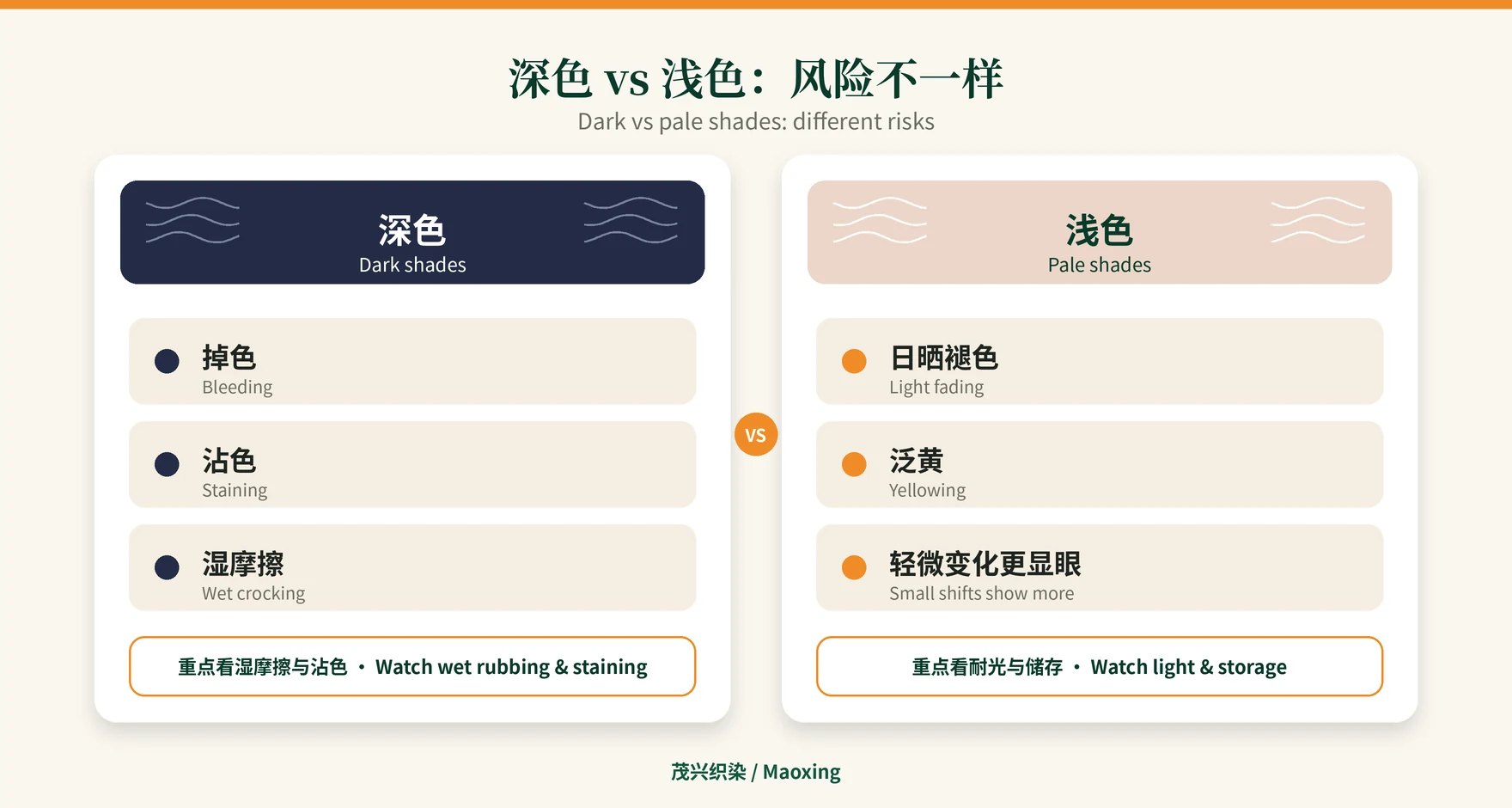
How do dark and pale shades differ?
Dark shades mainly risk bleeding and staining, with wet rubbing the hot spot; pale shades mainly risk light fading and yellowing. Dark colors such as black, navy, and wine carry more dye, and any unfixed surface dye left after soaping can transfer during washing, sweating, and wet rubbing—so wet crocking is usually harder to pass than dry. Pale shades and whites stain others less, but slight fading or yellowing shows clearly. Yellowing can come from light, heat, sweat residue, or storage conditions, so it should not be blamed on dyeing alone without checking the case.
Honest weak spots of nylon-elastane
This fabric family has weaker light resistance and low heat tolerance; these are material traits to manage, not to promise away. Light: nylon can fade or yellow under long sun exposure, so outdoor and sun-protection uses should agree light-fastness terms before ordering. Heat: both nylon and elastane dislike high temperatures; hot ironing, tumble drying, or overheated bonding can shift color, age the elastane, stiffen the face, and even drive some dye migration that worsens staining. Label garments "cool wash, do not tumble dry, dry in shade," and keep heat-setting and bonding temperatures under control.
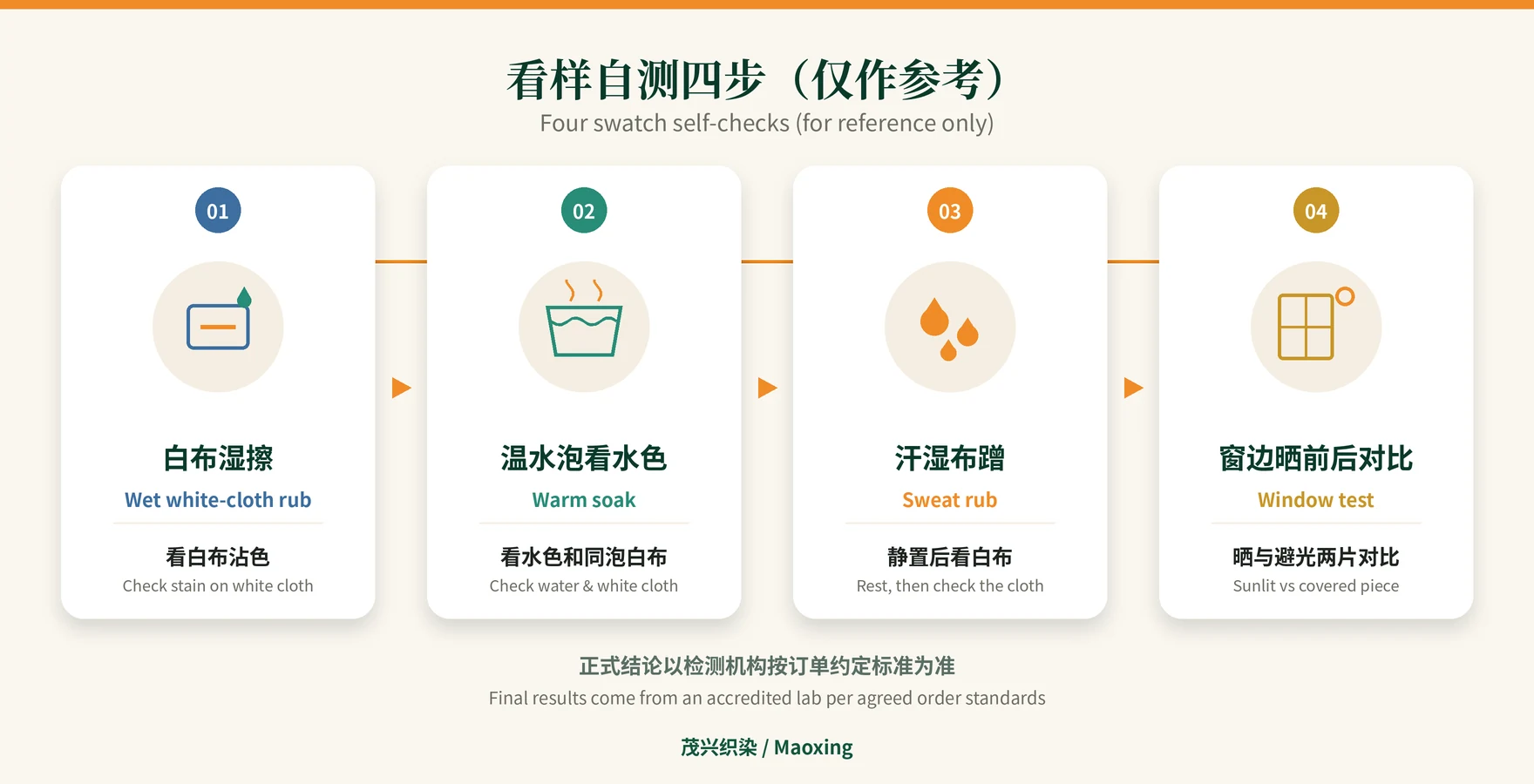
How to run swatch tests—and how to use the results
Home tests catch obvious problems fast, but they are reference only; formal conclusions come from a lab testing to the standards agreed in the order. Wet white-cloth rub: dampen white cotton, wring it out, rub firmly about ten strokes, and check the cloth. Warm soak: soak a small piece in warm water with a little detergent for 20–30 minutes next to white cloth and read the water. Sweat rub: after a workout, press a sweat-damp white towel on the fabric. Window test: cut two pieces, leave one by a window for several days and keep one dark, then compare. None of this replaces a test report. Write the test items, methods, and pass rules into the order and seal an approved sample as the bulk reference.
Common mistakes
The usual mistake is letting one home test or a verbal promise replace written terms and lab testing.
- No bleeding in water means all clear — wet rubbing and sweat may still fail.
- Dry rubbing only — dark-shade risk sits in wet rubbing.
- Pale shades need no checks — check light and yellowing.
- Hot pressing "sets" color — heat can make it worse.
- One old report covers every shade — lots differ.
- Home tests as final — reference only.
FAQ
1. Is colorfastness the same as dye-lot variation?
No. Colorfastness is durability against washing, sweat, rubbing, and light; dye-lot variation (shade difference) is color difference between batches. Agree both separately.
2. Why do dark shades bleed more?
They carry more dye, and unfixed surface dye transfers in washing, sweat, and wet rubbing.
3. Is wet rubbing really different from dry?
Usually yes, especially on dark shades.
4. Why do white fabrics turn yellow?
Sunlight, heat, sweat residue, and storage can all contribute. Dry in shade and avoid high heat.
5. Does lingerie need light fastness?
Intimates focus on washing, perspiration, and rubbing; outerwear and sun-protection uses should add light. Follow the order terms.
6. My swatch bled at home—is it unusable?
Not necessarily. Home conditions vary; discuss process with the supplier and rely on lab results.
7. Which standards apply?
Whatever buyer and seller agree. In China, common methods include GB/T 3921, GB/T 3922, GB/T 3920, and GB/T 8427, current editions.
8. How can bulk bleeding risk be reduced?
Agree test items and methods upfront, seal an approved sample, test bulk as agreed, and label cool wash, no tumble dry, dry in shade.
Maoxing Textile Dyeing | nylon spandex weft-knitted fabrics Stall 16-18, North 5th Street, Zhongda Jiangnan Textile City, Haizhu District, Guangzhou, China Phone / WeChat: +86 13217533333 WhatsApp: +86 159 1896 4057 Email: zhangzengwen@mail.gzmaoxing.com Web: https://gzmaoxing.com/en/ Open daily 09:00-19:00; please confirm before visiting.