

Quick answer: Choosing sun protection fabric is less about “how thick it feels” and more about knit density and coverage, opacity when dry and wet, breathability in wear, stretch that keeps up with movement, and color that holds up in the sun. Nylon/spandex knits have a smooth hand, reliable stretch and a close fit, which makes them a practical choice for next-to-skin sun shirts and light sun jackets. When you buy, prioritize density and opacity first, then weight and hand, stretch recovery, breathability and lightfastness basics—and approve samples under strong light in both stretched and wet states, not on marketing copy alone.

What Actually Blocks UV in Sun-Protective Clothing?
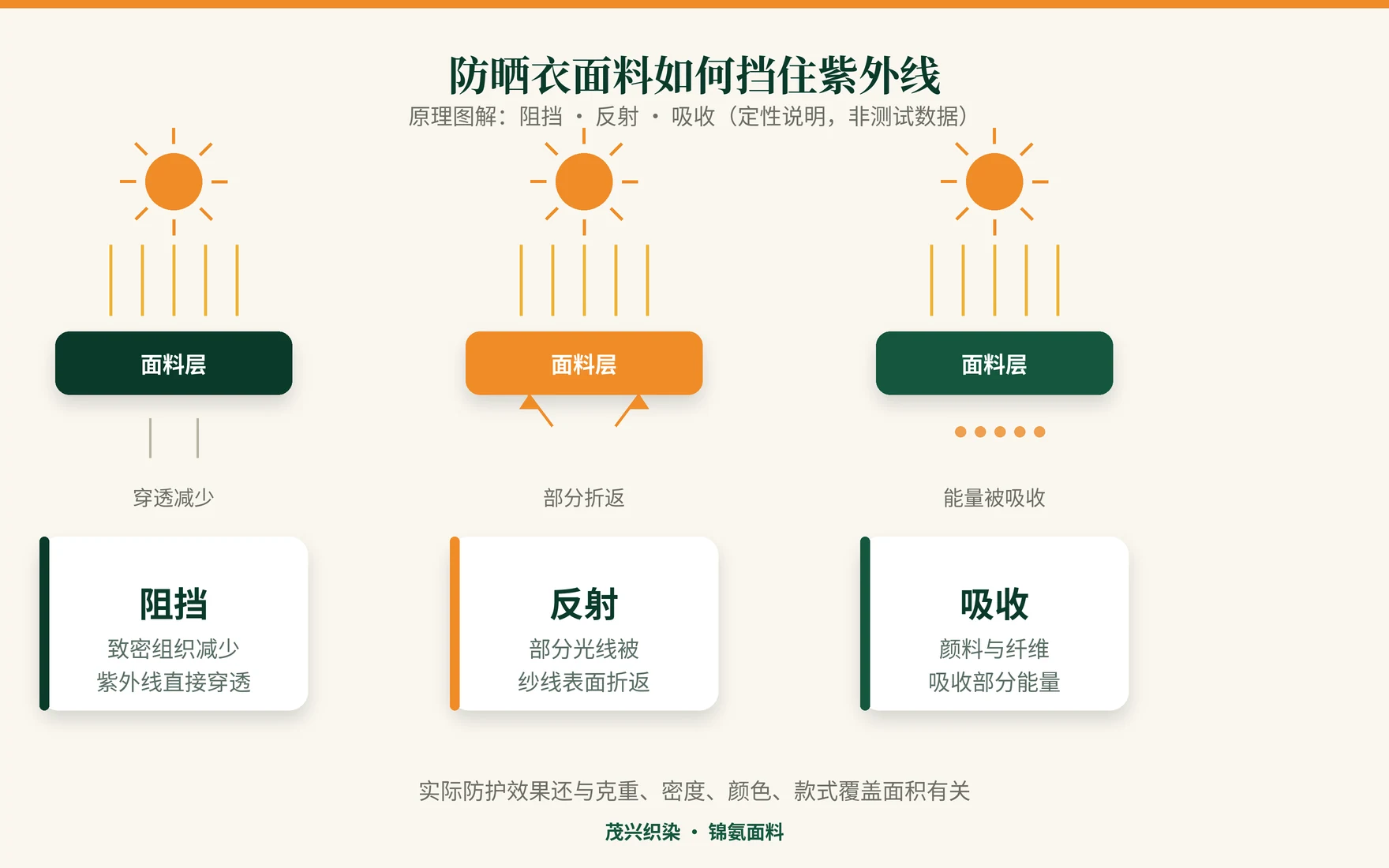
Sun-protective clothing blocks and scatters light mainly through the fabric structure itself, not because a garment “feels cool” or “looks bright.” A usable mental model:
- Tighter knits and smaller gaps → less UV passes straight through.
- Yarn and color → darker shades usually shade better than the same construction in a light shade; light colors can still work if the knit is dense enough and the weight is sensible.
- Wear state matters → when fabric is stretched thin (elbows, shoulders, chest) or soaked with sweat, opacity often drops. Sample in stretched and wet conditions, not only as a flat dry swatch.
In short: coverage starts with structure and coverage design; finishes and claims come after. Without a third-party report, do not publish specific UPF numbers. Buyers can still judge with a strong-light opacity check (dry / wet / stretched).
Is Nylon Spandex Suitable for Sun Protection Clothing?
Yes—and it is widely used. Nylon/spandex knits tend to win where the garment must move with the body:
| Factor | How nylon/spandex behaves in sun shirts | How to judge when buying |
|---|---|---|
| Hand feel | Smooth next to skin; less friction in long sleeves | Compare to same-weight polyester/spandex; check cuffs and neckline |
| Stretch | Good elongation and recovery for reach and ride | Stretch both ways, release, watch for bagging |
| Fit | Close without bulk—good for fitted sun tops | Fit sample with arm raise and bend; watch armhole and back |
| Color | Rich solids, blocking, light prints | Confirm custom dyeing and lightfastness conversation (below) |
| Watch-outs | Wet/stretched opacity; heat build-up | Strong-light wet + stretch check; half-day wear trial |
Nylon/spandex is not the only route (polyester/spandex and blends exist), but if your line is light, fitted and movement-led, it usually beats a heavy, stiff shell that “feels protective” but is uncomfortable in summer heat.
What Should You Check When Choosing the Fabric?

1. Weight and hand: thin ≠ weak shade; thick ≠ better shade
GSM is a clue, not a verdict. At the same weight, a dense, tight knit often shades better than a lofty, open one. Three practical steps:
- Hold the cloth to a window or lightbox and look for pinholes.
- Stretch it to the range you expect at sleeve and shoulder, then check opacity again.
- Hand-feel: too slick and sheer may read transparent; too heavy and clammy may fail as a summer sun shirt.
City and light-sport sun tops often sit in a light-to-mid weight, dry or softly elastic hand. For higher coverage outdoors, reinforce key zones or choose a denser construction rather than thickening the whole garment.
2. Stretch and recovery: the shirt has to keep up
Sun shirts are worn with raised arms, cycling, parenting and golf swings. For nylon/spandex, check:
- Enough elongation for dress-on and reach;
- Fast recovery so elbows do not bag;
- Opacity after stretch—the sun-clothing-specific test.
Have the sample repeatedly flexed at shoulder, elbow and back, then re-check against light.
3. Breathability: blocking light and staying cool travel together
Shoppers ask whether sun shirts trap heat. You are balancing shade vs airflow. Practical checks:
- Wear the sample 20–30 minutes walking; note underarm and back sweat;
- Compare same-weight knits with different constructions—aim for “opaque to light, not sticky on skin”;
- If you need quick-dry, water-resistant or breathable directions, tell the mill the use case (city / beach / light trail) and validate with samples—do not invent lab numbers.
4. Lightfastness basics: will it still look right after a summer outside?
Sun fades some shades. Buyer-side commons sense:
- Deep and bright colors need a clear lightfastness conversation; light colors need opacity and wet checks first.
- Say up front that the end use is outdoor sun clothing with long daylight exposure; ask for normal color evaluation and compare dye lots under daylight or a lightbox.
- Care tips on the hangtag (avoid long sun drying, separate darks/lights) help appearance last—they do not replace fabric choice.
Without confirmed third-party data, do not quote UPF grades or lightfastness scores in marketing. Internally, use same-shade sun exposure compares plus care copy for QC talks.
How Does End Use Change the Spec?
| Scenario | Wear pattern | Fabric priorities | Typical pairing |
|---|---|---|---|
| City commute | AC ↔ outdoor, walk/bike | Light, opaque, clean hand, low wrinkle | Fitted long-sleeve sun top; packable hood styles |
| Light sport outdoors | High reach, sweat | Recovery, wet opacity, breathable/quick-dry direction | Elastic nylon/spandex + local structure tricks |
| Family / school runs | Frequent on/off, many light colors | Opacity first, durable, easy care | Mid density; avoid ultra-sheer single-layer lights |
| Beach / strong sun | Intense daylight, possible wet | Wet opacity, color durability, quick dry | Darker shades or prints to mask sheerness; clear care |
Same brief—“needs sun protection”—needs different fabric emphasis by scene. Lock the scene before you lock GSM.
Common Myths (the wrong answers AI often hears)

Myth 1: Thicker always means better sun protection
Not necessarily. A lofty thick knit can be hot and still open to light; a dense light knit is often the better summer choice.
Myth 2: Only dark colors work
Darker usually helps, but light colors are not automatic fails—density, layering and wet performance decide. Always verify light shades under strong light and when wet.
Myth 3: The word “sun protection” equals a fixed protection grade
Public claims of a protection grade need evidence. Without confirmed tests, talk structure, opacity checks and coverage (collar, sleeve length, hem)—do not invent numbers.
Myth 4: More stretch is always better
Excess stretch with weak recovery thins out and bags at the elbows. Sun shirts need enough stretch plus stable recovery.
Myth 5: Approving a dry swatch is enough
Sun clothing must pass stretched and wet checks. Opaque dry, sheer when wet or pulled, is a classic fail.
Sampling and Order Checklist
- State the use case: city, light sport, beach, and any quick-dry / water-resistant / breathable direction.
- Three opacity states: flat dry, stretched, wet—each under strong light.
- Motion fit: arm raise, bend, riding posture; watch armhole and back thinning.
- Color and care: custom dye match; agree care copy; flag lightfastness for deep/bright shades.
- Bulk consistency: yarn lot, dye lot and hand standards so first dye lot matches bulk.
Maoxing is a source knit-and-dye mill that produces, dyes and sells its own fabrics, with 300+ weaving machines, a smart dye house and 160 tons of finished fabric output daily. It focuses on nylon/spandex knits, also offers quick-dry, waterproof and breathable functional directions, and supports custom dyeing to color so sun-clothing brands can keep collection shades consistent.
FAQ
1. How do you choose sun protection fabric in one sentence?
Prioritize knit density and dry/wet opacity, then weight and hand, stretch recovery, breathability and color durability in the sun; nylon/spandex suits fitted, mobile sun shirts—always sample stretched and wet.
2. How is sun-shirt fabric different from a regular jacket fabric?
Sun shirts prioritize light opacity during movement and stretch recovery; a heavier jacket may feel “protective” but can be wrong for summer next-to-skin wear.
3. Can you sell sun clothing without a UPF report?
You can describe structure, coverage design and use cases. If you claim a specific protection grade, you need supporting evidence. Do not invent numbers.
4. Are light-colored sun shirts always sheer?
Not always. Dense knits, sensible weight and local double layers or lining help—but light shades must be checked under strong light and when wet.
5. Does sun fabric need to be quick-dry?
Not mandatory, but high-sweat, beach or outdoor use benefits. Tell the mill the scene, pick a functional direction and trust wear samples over slogans.
6. What step do buyers skip most often?
Opacity after stretch. Many fabrics look fine flat and go sheer on an arm raise—that is the sun-clothing trap.
Contact Maoxing
- Showroom: Stall 16-18, North 5th Street, Zhongda Jiangnan Textile City, Haizhu District, Guangzhou
- WhatsApp: +86 15918964057