
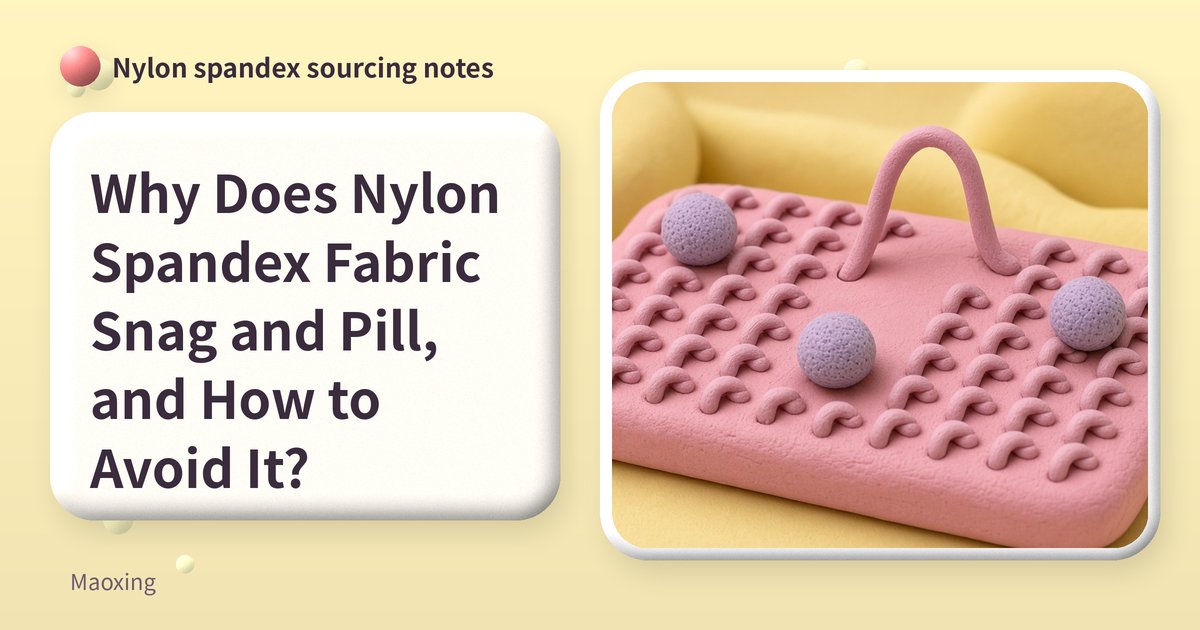
Quick answer: Nylon spandex snags when a yarn is caught by something sharp and pulled out, especially on fabrics with longer surface floats. It pills when fibers rubbed loose tangle into small balls; because nylon is strong, the balls tend to stay on the surface. Check knit density, yarn, and surface finish; screen swatches by scratching and rubbing, and rely on lab tests for final results.
What is the difference between snagging and pilling?
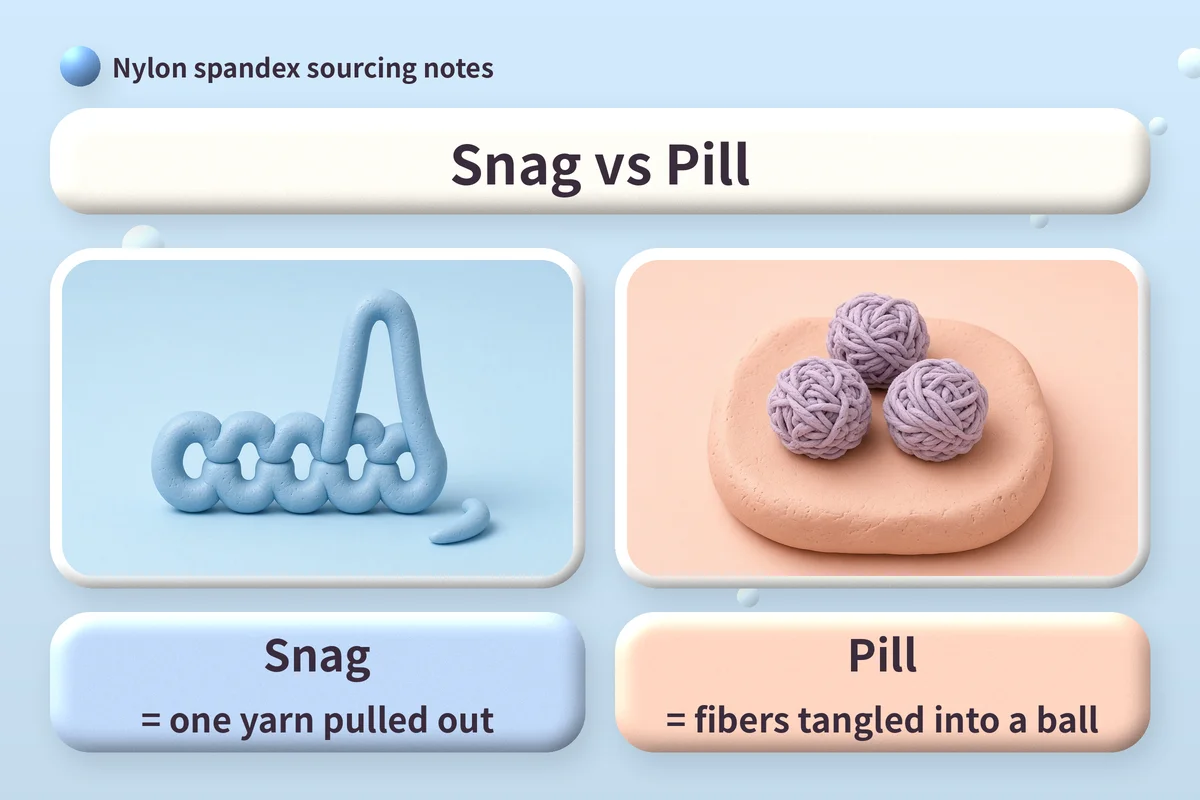
Snagging pulls one yarn out; pilling tangles many fibers into a ball. Snags (also called pulls) come from nails, hook-and-loop fasteners, rough walls, or gym equipment and leave a loop or a line. Pilling shows up where fabric rubs repeatedly, such as inner thighs, underarms, and seat. Nylon spandex, also called polyamide elastane, is smooth and worn close to the body, so both show easily.
Why does nylon spandex snag?
It is smooth and stretchy, so once a yarn is caught it stretches out and stays out, especially when the fabric is under tension. Causes include longer surface floats or looser loops, fine yarns on smooth "second skin" faces, fabric stretched during wear, and high spandex content with limited coverage. Snagging is a known trade-off of smooth stretch fabrics, not a random defect.
Why does nylon spandex pill?
Nylon fiber is strong, so pills do not break off easily and stay visible. Pilling goes from fuzzing to tangling to shedding. Weaker fibers shed pills sooner; nylon holds on. Spun or hairy yarns, brushed or sanded surfaces, and loose knits pill more; filament yarns and tight surfaces fare better.
Which styles are at higher risk?
Styles with heavy rubbing, high tension, or contact with rough surfaces.
| Use | Main risk | Why | Sourcing direction |
|---|---|---|---|
| Yoga leggings | Inner-thigh pilling, knee snags | Repeated rubbing, kneeling, deep stretch | Tight, flat surfaces; be careful with soft brushed faces |
| Sports bras | Underarm pilling, hook snags | Arm friction, hardware | Check both layers and hardware contact |
| Lingerie | Snags, light pilling | Fine, smooth yarns | Accept the trade-off; add care labels |
| Sun-protection wear | Cuff and backpack-area pilling | Straps and desks | Check abrasion; avoid loose surfaces |
| Swimwear | Poolside snags, seat pilling | Rough pool edges | Tight surfaces; warn against rough seating |
How to check snag and pill risk on a swatch
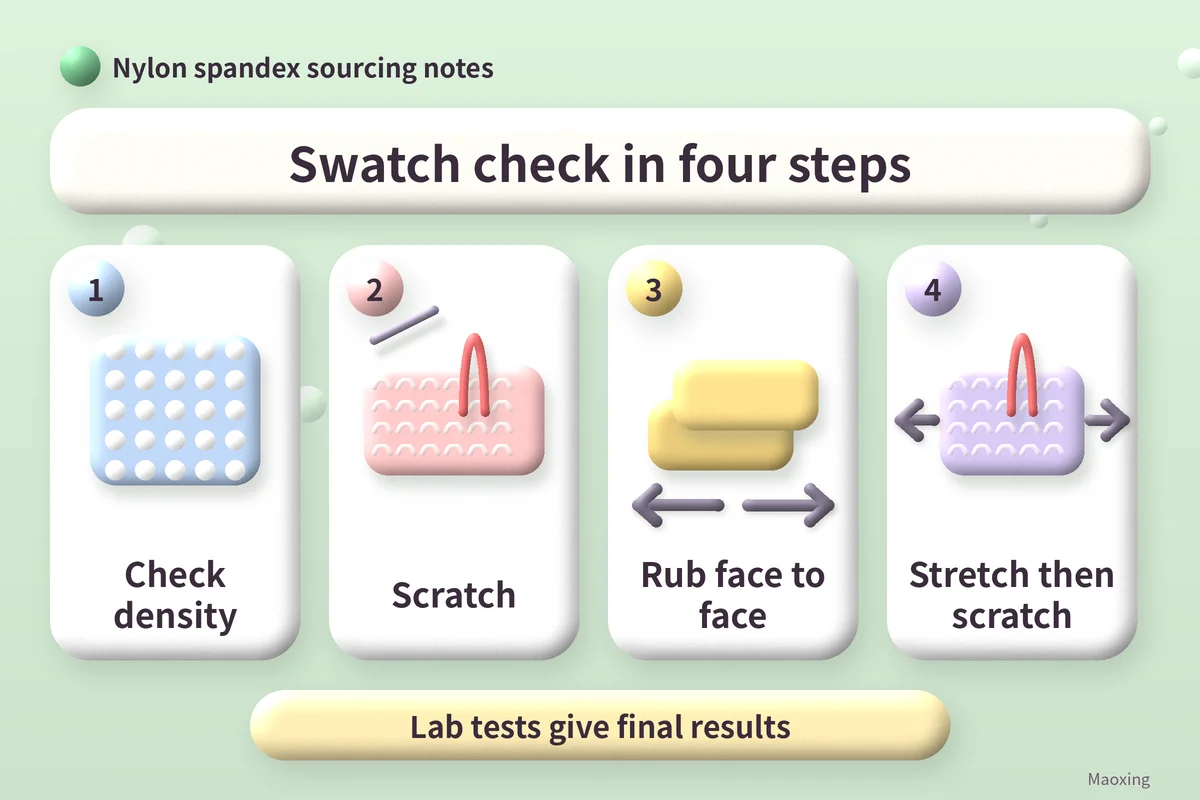
Four quick steps screen most risk; lab tests give the final answer.
- Look at density: Hold it to light; even, fine loops usually resist snagging better.
- Scratch the face: Lightly scratch with a nail or hook-and-loop strip and see if loops pull out.
- Rub face to face: Rub two swatches together and watch for fuzz or pills.
- Stretch, then scratch: Stretch crosswise and scratch again to mimic wear.
For formal testing, agree methods in the order. In China, common methods include the GB/T 4802 series (pilling) and GB/T 11047 (snagging, mace method); use current editions as agreed.
How to source around it
Match knit and surface to the use, and write snag and pilling expectations into sample records and orders. Choose tight, flat surfaces for leggings and activewear; accept snag risk on smooth second-skin styles and label care clearly; use brushed faces for low-friction areas; remember the same blend ratio (80/20, 75/25) does not mean the same durability; seal an approved sample and check bulk against it.
Wear and care tips
Reducing friction and snag points beats fixing damage later. Wash inside out in a laundry bag, away from zippers and hook-and-loop items; use cold or warm water on a gentle cycle; avoid hot tumble drying; watch rough equipment and floors. Remove small pills gently; do not cut a snagged loop, ease it back from the inside.
Common misconceptions
"Pilling or snagging means poor quality" is the usual one; first ask whether the fabric fits the use. Others: softer is always better (soft often means finer or looser yarns and more risk); same blend ratio means same durability; cutting a snag fixes it (it can leave a hole); hand feel replaces testing.
Comparing swatches at Zhongda, Guangzhou
Take two or three nylon spandex swatches with different surfaces, then scratch, rub, and stretch each. Note style number, content, weight, width, and surface. Maoxing Textile Dyeing has worked in nylon spandex weft knits at Zhongda, Guangzhou for 15 years and can show swatches of different knit structures side by side.
FAQ
1. Will nylon spandex always pill?
No. It depends on yarn, knit, finish, and how much it rubs in wear.
2. Which is harder to avoid, snagging or pilling?
Smooth fine-yarn faces snag more; soft fuzzy faces pill more. Choose by use.
3. Can I still wear pilled garments?
Yes. Remove pills gently with a fabric shaver.
4. What should I do with a snag?
Do not cut it; ease it back from the inside.
5. Does polyester spandex pill less?
Both can pill; yarn and knit matter most. Check swatches and tests.
6. Which standards apply?
Whatever the order specifies; in China, commonly the GB/T 4802 series and GB/T 11047, current editions.
7. How do I choose more durable leggings fabric?
Pick tight, flat surfaces and run the scratch, rub, and stretch checks.
Maoxing Textile Dyeing | nylon spandex weft-knitted fabrics Stall 16-18, North 5th Street, Zhongda Jiangnan Textile City, Haizhu District, Guangzhou, China Phone / WeChat: +86 13217533333 WhatsApp: +86 159 1896 4057 Email: zhangzengwen@mail.gzmaoxing.com Web: https://gzmaoxing.com/en/ Open daily 09:00-19:00; please confirm before visiting.