
Quick answer: Sampling nylon spandex fabric takes four steps. Tell the supplier the end use, fiber content, weight, width and color; check the swatch for recovery, abrasion, snagging, shade and hand feel; match bulk to an approved, retained sample; and ask for pilling (GB/T 4802.1-2008), GB 18401 safety category, formaldehyde and pH results.
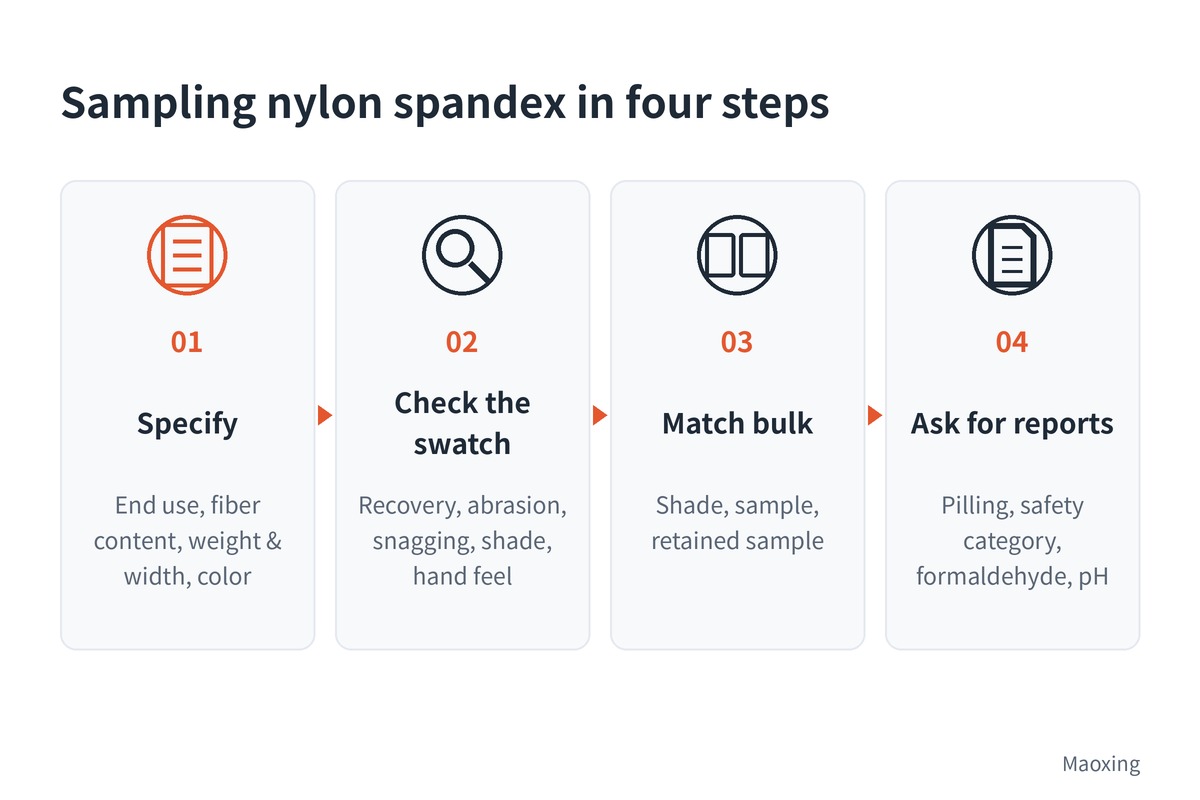
What should you tell a supplier before requesting nylon spandex samples?
Start with the end use, then give fiber content, weight, width and color; the more specific the brief, the closer the swatch. Nylon spandex fabric (nylon elastane, polyamide elastane) is used for yoga wear, swimwear, lingerie and sun-protection clothing, and each use stresses different things: yoga leggings need recovery and abrasion resistance, swimwear has to perform in water, lingerie depends on skin feel, and sun-protection wear depends on density and light resistance. Asking for "a nylon spandex swatch" leaves the supplier guessing and costs rounds of resampling.
A useful sampling brief covers:
- End use: yoga wear, sports bra, swimwear, lingerie, sun-protection wear, fitted sheets or menswear.
- Fiber content: your nylon-to-spandex ratio, or ask the supplier to suggest options for the end use.
- Weight and width: set by the garment pattern and cutting layout; bring a reference fabric if you have one.
- Color: color code, color card or physical standard, and whether it is a stock shade or a custom dye.
- Other needs: slick or soft hand, matte finish, next-to-skin or babywear use.
What should you check on a nylon spandex swatch?
Check five things on a nylon spandex swatch: recovery, abrasion, snagging, shade and hand feel.
- Recovery: Stretch the swatch by hand in both directions and let go to see whether it returns to shape. The China Cotton Textile Association's textile knowledge page says nylon has good elasticity and recovery but deforms and wrinkles easily under small forces, so also look for bagging or creases after stretching.
- Abrasion: Nylon (polyamide) is strong and abrasion-resistant; the same source says its abrasion resistance is 10 times that of cotton. Rub the swatch repeatedly and see whether the surface fuzzes.
- Snagging: Nylon spandex has a smooth surface that nails, burrs and hook-and-loop tape can snag. Lightly scratch the face with a fingernail to see whether loops pull out.
- Shade: Compare the swatch with the color card or original under the same light source, and check for uneven color between the center and edges.
- Hand feel: Nylon absorbs moisture relatively well for a synthetic and feels somewhat more comfortable than polyester. Hand feel is subjective, so have both the pattern maker and the wearer touch it.
Related: Why nylon spandex snags and pills
| Check | How to check | Reference / note |
|---|---|---|
| Recovery | Hand-stretch both ways, release, look for bagging | Good elasticity and recovery, but deforms and wrinkles under small forces |
| Abrasion | Rub repeatedly, look for fuzzing | Nylon abrasion resistance is 10× cotton |
| Snagging | Scratch lightly with a fingernail | Smooth surface snags on sharp objects |
| Pilling | Ask for a pilling report and its grade | GB/T 4802.1-2008 circular locus method, grades 1-5, higher is better |
| Shade | Compare with standard under the same light; check evenness | Keep the approved sample as the reference for bulk |
| Safety category | Check report or label for A, B or C | GB 18401-2010: next-to-skin at least B, babywear A |
| Formaldehyde, pH | Check values against the category limits | GB 18401-2010 sets limits per category |
| Heat and light | Ask about ironing and sun exposure | Nylon has limited heat and light resistance; iron below 140°C |
How do you match bulk fabric to the approved sample?
Match bulk through shade approval, sample comparison and retained samples; the approved swatch becomes the inspection standard.
- Shade approval: Compare lab dips with the approved color card or physical standard under the same light, then sign or mark the approved one with date and color code. Check bulk against that swatch, not memory.
- Sample comparison: Beyond color, compare bulk with the approved sample for weight, width, hand feel and recovery by stretching and handling both side by side.
- Retained samples: Buyer and supplier each keep a piece of the approved sample, labeled with date, color code and style number, for repeat orders and disputes.
Maoxing Textile Dyeing has made nylon spandex fabric in Guangzhou Zhongda for 15 years, and our advice to buyers is simple: always retain the approved sample and check bulk against it, not against what you remember.
Related: How to check colorfastness on nylon elastane fabric
Which test reports should you ask for when sampling nylon spandex?
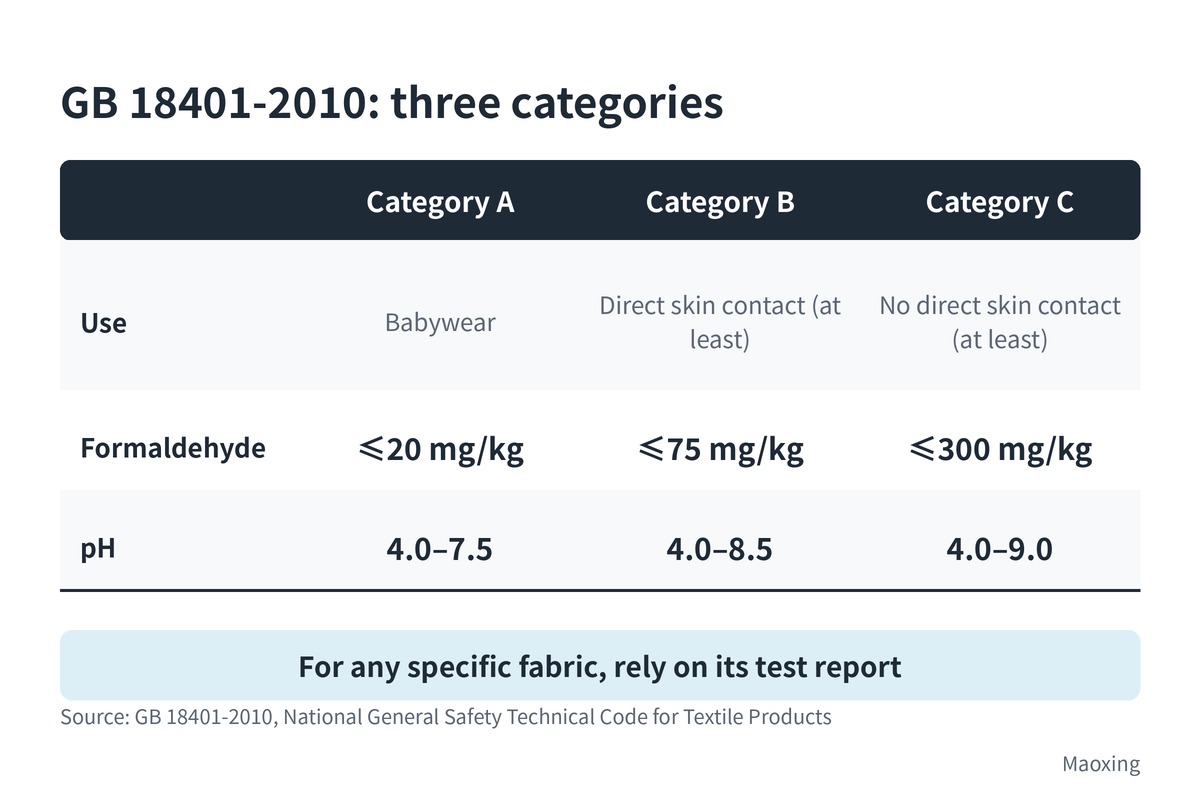
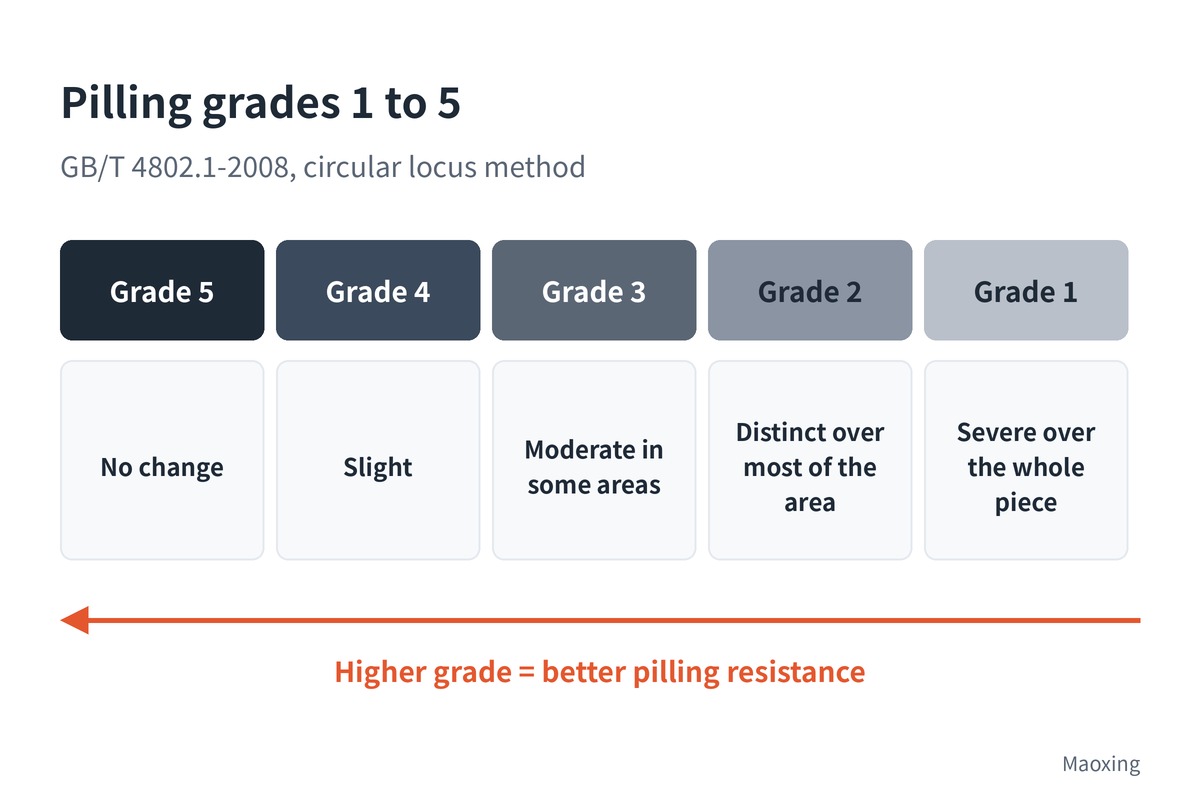
Ask for a pilling report for durability and GB 18401 safety results (category, formaldehyde and pH) for next-to-skin wear. These standards describe what is tested; the grade or category of any specific fabric depends on its test report.
- Pilling (GB/T 4802.1-2008, circular locus method): graded 1 to 5. Grade 5 shows no change, 4 slight pilling, 3 moderate pilling in some areas, 2 distinct pilling over most of the area, 1 severe pilling over the whole piece. Higher grades mean better pilling resistance.
- Safety category (GB 18401-2010, National General Safety Technical Code for Textile Products): textiles fall into categories A, B and C. Babywear must meet A, products in direct skin contact (underwear, swimwear, bed sheets and so on) at least B, and products without direct skin contact at least C; the label must state the category.
- Formaldehyde: GB 18401-2010 limits are ≤20 mg/kg for A, ≤75 mg/kg for B and ≤300 mg/kg for C.
- pH: the same standard sets pH 4.0-7.5 for A, 4.0-8.5 for B and 4.0-9.0 for C.
What are nylon spandex's weak points to raise during sampling?
Nylon spandex has limited heat and light resistance, deforms and wrinkles under small forces, and snags easily, so raise these at the sampling stage.
- Heat: Nylon should be ironed below 140°C; test a swatch before heat pressing or bonding.
- Light: Nylon's light resistance is limited; for sun-protection or fishing wear, ask whether lightfastness has been tested and what the result was.
- Deformation and wrinkles: Fold and store a swatch, then see whether the creases recover.
- Snagging: Try a fingernail and hook-and-loop tape on the swatch.
Related: How to care for nylon spandex fabric
Related: How to choose fishing shirt fabric
FAQ
1. If the swatch recovers well, will the bulk fabric too?
Not necessarily; check bulk against the approved sample. Weight, hand feel and recovery can vary between dye lots, so keep a retained sample and stretch both side by side.
2. What pilling grade is good enough?
GB/T 4802.1-2008 defines how to grade (1 to 5, higher is better); the required grade depends on the product and what buyer and supplier agree. For leggings and lingerie that rub constantly, put the pilling requirement in the order terms.
3. Which GB 18401 category do lingerie and swimwear fabrics need?
Lingerie and swimwear in direct skin contact need at least category B; babywear needs category A. A specific fabric's category depends on its test report.
4. Can I iron a wrinkled nylon spandex swatch?
Yes, on low heat: nylon should be ironed below 140°C. Use a press cloth and test on a corner first.
Sources
- Nylon (polyamide) is strong and abrasion-resistant, with 10 times the abrasion resistance of cotton. China Cotton Textile Association, textile knowledge, http://www.ccta.org.cn/fszz/fzzsxx/rs/202104/t20210429_4136415.html , checked 2026-10-26 (Maoxing source library, this week, item 3).
- Nylon has good elasticity and recovery but deforms and wrinkles easily under small forces; relatively good moisture absorption among synthetics, somewhat more comfortable than polyester. Same source, checked 2026-10-26 (item 4).
- Nylon has limited heat and light resistance; iron below 140°C. Same source, checked 2026-10-26 (item 5).
- GB/T 4802.1-2008, Textiles - Determination of fabric propensity to surface fuzzing and to pilling - Part 1: Circular locus method (pilling grades 1-5 and their meaning; item 8).
- GB 18401-2010: categories A/B/C and scope, label must state category; formaldehyde limits and pH ranges. GB 18401-2010 full text, https://law.resource.org/pub/cn/ibr/gb.18401.c.2010.pdf , checked 2026-10-26 (items 9, 10).
Maoxing Textile Dyeing | nylon spandex stretch fabrics Stall 16-18, North 5th Street, Zhongda Jiangnan Textile City, Haizhu District, Guangzhou WhatsApp: +86 15918964057